We are all earthlings.
As earthlings our collective goal is ultimately survival; survival for the individual and for the group.
As humans, we have (unjustifiably) divided ourselves from the rest of the animal population. For humans, it’s no longer about survival ... it’s about being the best; having the best; even at the expense of those people and other animals who are still solely grasping for survival.
Watch this movie. It will ruin any shred of the pleasant ignorance or denial that so many people have conveniently held on to. We all live in reality though; and this, unfortunately, is reality.
This clip is only a few minutes long. I watched the entire 1.5 hour movie, and I encourage you to as well.
Showing posts with label food. Show all posts
Showing posts with label food. Show all posts
Thursday, January 27, 2011


Saturday, October 16, 2010
The Worst Human Epidemic?
Will egotism kill the human race?
Population control.
As defined by the ever awesome Wikipedia;
"the practice of artificially altering the size of any animal population besides humans. It typically refers to the act of limiting the size of an animal population so that it remains manageable, as opposed to the act of protecting a species from excessive rates of extinction, which is referred to as conservation biology."
This is typically done through 'animal euthanasia' (culling??) and neutering.
I think it's safe to say, however, that the population number, and growth, to be most feared is our own ... the human population continues to grow ... more and more people suffer from poverty, disease and abuse ... the pollution from overcrowded cities ... and perhaps the most hypocritical part of it all is that we are endangering other species through environmental / habitat destruction to support our own growth.
The question is (more rhetorical than anything): why, when many people (scientists and politicians perhaps..) express such a keen interest in maintaining the health and general welfare of the environment and wildlife populations, do so many see such measures on the human population as a crime or 'unthinkable'?
I present to you a couple of images, retrieved from google, depicting the consequences of human population growth:


Not really difficult to interpret these graphs, but for the sake of getting the message across, it's obvious that if human population growth continues the way it is, the consequences for the planet will be dire.
A quote which I think emphasises an important issue of population growth which is perhaps less considered than it should be in an age where technological advancements are strengthening our desire to live longer and stronger, defying age, and in turn cementing our opinion that we are superior;
"While the human population grows, the earth's size and resources remain the same. Technology can increase the amount of food that can be produced on a piece of land, but it cannot increase the amount of land and water on the planet."
Furthermore, I believe this particular paragraph;
"Environmental problems are aggravated by population explosions. More people means more resources and energy are consumed and more pollution is created and more waste is sent to landfills. More land is needed to grow crops and build houses. More trees are cut down for new homes. More cars are built, more fossil fuels are used, and more gases are released into the environment. More natural wilderness areas or beautiful landscapes are destroyed to provide resources and cropland. In short, population growth makes other environmental problems harder to solve."
sums up well my thoughts on why it is less important to settle the debate on climate change / global warming than it is to act on changing our behaviour for the problems we know and agree exist.
I highly recommend you read this article

Population control.
As defined by the ever awesome Wikipedia;
"the practice of artificially altering the size of any animal population besides humans. It typically refers to the act of limiting the size of an animal population so that it remains manageable, as opposed to the act of protecting a species from excessive rates of extinction, which is referred to as conservation biology."
This is typically done through 'animal euthanasia' (culling??) and neutering.
I think it's safe to say, however, that the population number, and growth, to be most feared is our own ... the human population continues to grow ... more and more people suffer from poverty, disease and abuse ... the pollution from overcrowded cities ... and perhaps the most hypocritical part of it all is that we are endangering other species through environmental / habitat destruction to support our own growth.
The question is (more rhetorical than anything): why, when many people (scientists and politicians perhaps..) express such a keen interest in maintaining the health and general welfare of the environment and wildlife populations, do so many see such measures on the human population as a crime or 'unthinkable'?
I present to you a couple of images, retrieved from google, depicting the consequences of human population growth:

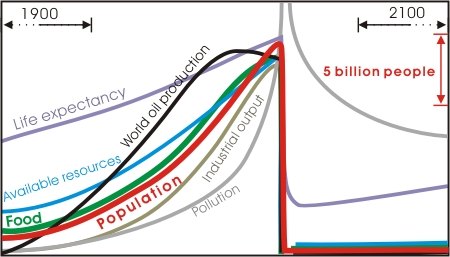
Not really difficult to interpret these graphs, but for the sake of getting the message across, it's obvious that if human population growth continues the way it is, the consequences for the planet will be dire.
A quote which I think emphasises an important issue of population growth which is perhaps less considered than it should be in an age where technological advancements are strengthening our desire to live longer and stronger, defying age, and in turn cementing our opinion that we are superior;
"While the human population grows, the earth's size and resources remain the same. Technology can increase the amount of food that can be produced on a piece of land, but it cannot increase the amount of land and water on the planet."
Furthermore, I believe this particular paragraph;
"Environmental problems are aggravated by population explosions. More people means more resources and energy are consumed and more pollution is created and more waste is sent to landfills. More land is needed to grow crops and build houses. More trees are cut down for new homes. More cars are built, more fossil fuels are used, and more gases are released into the environment. More natural wilderness areas or beautiful landscapes are destroyed to provide resources and cropland. In short, population growth makes other environmental problems harder to solve."
sums up well my thoughts on why it is less important to settle the debate on climate change / global warming than it is to act on changing our behaviour for the problems we know and agree exist.
I highly recommend you read this article

Monday, October 4, 2010
Happy World Animal Day!
World Animal Day certainly seems a fitting topic for a blog observing and, in some ways, attempting to analyse the world; animals are a crucial part of the world and its atmosphere.. and no, I don't necessarily mean 'atmosphere' in terms of the gases circulating the globe.. I'm talking about the general emotional experience on Earth.
Animals are therapeutic. They're protective; they're nurturing. They're loyal. They (mostly) love unconditionally. They're intelligent.. much more so than many humans will give them credit for.
A youtube search for 'animal heroes' is simple proof of how incredible they are, and can be. Here's a video detailing the Animal Heroes of 2006 - Animals that have saved human lives and showed outstanding bravery, courage and intelligence:
It also seems fitting to include a few awesome quotes:
"The greatness of a nation and its moral progress can be judged by the way its animals are treated." - Ghandi
"Aerodynamically, the bumble bee shouldn't be able to fly, but the bumble bee doesn't know it so it goes on flying anyway." - Mary Kay Ash
"Horse sense is the thing a horse has which keeps it from betting on people." - W. C. Fields
"A dog is the only thing on earth that loves you more than he loves himself." - Josh Billings
Finally, the Universal Declaration on Animal Welfare - please read and sign the petition - it takes just a few moments of your time.
www.udaw.org
http://www.animalsmatter.org/en/campaign_resources/
And finally (for real this time!) a thought to ponder...
"One interesting finding is that 99% of Australians are against cruelty to animals, yet 98% eat animals and fish that come from cruel, intensive farming practices!" (A Pound of Flesh, http://www.scribd.com/doc/26880337/APF-VVSQ)
As Ghandi says.. 'you must be the change you want to see in the world'.
Here's to all animals
Animals are therapeutic. They're protective; they're nurturing. They're loyal. They (mostly) love unconditionally. They're intelligent.. much more so than many humans will give them credit for.
A youtube search for 'animal heroes' is simple proof of how incredible they are, and can be. Here's a video detailing the Animal Heroes of 2006 - Animals that have saved human lives and showed outstanding bravery, courage and intelligence:
It also seems fitting to include a few awesome quotes:
"The greatness of a nation and its moral progress can be judged by the way its animals are treated." - Ghandi
"Aerodynamically, the bumble bee shouldn't be able to fly, but the bumble bee doesn't know it so it goes on flying anyway." - Mary Kay Ash
"Horse sense is the thing a horse has which keeps it from betting on people." - W. C. Fields
"A dog is the only thing on earth that loves you more than he loves himself." - Josh Billings
Finally, the Universal Declaration on Animal Welfare - please read and sign the petition - it takes just a few moments of your time.
www.udaw.org
http://www.animalsmatter.org/en/campaign_resources/
And finally (for real this time!) a thought to ponder...
As Ghandi says.. 'you must be the change you want to see in the world'.
Here's to all animals
Wednesday, August 5, 2009
Progress
I had an unsettling feeling after completing the last post. I was dissatisfied. I was dissatisfied even whilst reading through the draft edition, but posted it for the sake of progress. While the incompleteness of the post likely added to the feeling of dissatisfaction, it was something more to do with the content that I felt uneasy about. I'm still not sure what. Perhaps I didn't express myself as I normally like to, or perhaps it wasn't entirely honest. Maybe I just didn't completely understand what I wrote in my own mind.
However, progress is still progress. People and their work are judged, amendments may be required and the necessary changes implemented.
I want to apply this to a broader picture now. First, the background inspiration for this post: this evening whilst in a supermarket checkout, I noticed an overweight (I'd say approaching obese) girl, probably younger than ten. I attempted to inconspicuously watch the items they were putting through the checkout, and noticed a few tins of something (not really important) and a large bottle of coke. As I had no knowledge of their motive for shopping, it would be unfair of me to judge the lack of any type of fresh food (eg. fruits and vegetables). However, this one lot of purchases by two people I had seen only this one time could stand as a decent reflection of their typical lifestyle (it might not, there may have easily been unknown circumstances such as medical conditions or whatever event - but this is the conclusion I drew from looking at the girl).
To apply this to the focus of this post: how progressive has 'progress' proven to be up to the present time? Progress, by definition, is positive development. The past years have seen massive amounts of progress in medicine and technology, but how equally balanced are the positives with the negatives that arise from fraudulent application of these breakthroughs? (for example, businesses that employ different technologies in more economically efficient ways) A big progression in technology has been in food production, with farming systems 'progressing' to the extent where animal welfare may be compromised for the sake of a greater profit margin.
In simple terms, people have gone from growing fruits and vegetables and keeping cows in their paddocks' to (years later) purchasing goods from supermarkets which have (often unknown) preservatives, added hormones and other things of a potentially harmful nature. As food production and preservation and medicine progresses, so do potential threats to human and (other) animal health. So, how do we measure progression?
Subscribe to:
Posts (Atom)