Aerodynamically, it should be impossible for bees to fly.
This was, in actual fact, the belief until a more recent scientific study seeking to explain how the apparently impossible flight of bees occurs every day. (For more information on this study please visit http://media.caltech.edu/press_releases/12772)
Bees are responsible for pollination. Without bees, plants would find it much more difficult to reproduce.
The importance of bees:
Bee pollination of crops, something that most farmers rely heavily on, is responsible for as much as 30% of the US food supply. That doesn’t even consider what they mean for the rest of the world...
Just to raise the point even higher, here’s a list of the crops etc that require pollination from bees entirely or at least partially: Alfalfa, buckwheat, clover, Apple, apricot, avocado, berry, cherry, citrus, kiwi, mango, passion fruit, peach, pear, persimmon, plum, prune, Almond, cashew, chestnut, coconut, macadamia, cotton, flax, rape, safflower, soybeans, sunflower, asparagus, broccoli, brussel sprouts, carrots, cauliflower, celery, Chinese cabbage, collard, cucumber, dill, eggplant, garlic, kale, kohlrabi, leek, lima beans, mustard, onion, parsley, pepper, pumpkin, radish, rutabaga, squash, turnip, beans, cantaloupe, cucumbers, muckmelon, pumpkin, squash, watermelon, eggplant, lima beans, peppers. (and yes, some of these I haven’t even heard of...)
....To think this is all carried out by a small, rather fragile looking group (rather large in number, although decreasing) of insects.
Even scarier, to think that the majority of the credit for the diversity and health of the biosphere goes to a creature which, apparently, should find it impossible to even travel to carry out the job...
So when it comes down to it, it’d be fair to say our lives are based on something which shouldn’t be possible. Pretty amazing, huh?
What’s the point of my telling you this? It’s not about existence, not about survival; it’s about dreams. As Mary Kay Ash once said;
“Aerodynamically, the bumble bee shouldn’t be able to fly, but the bumble bee doesn’t know it so it goes on flying anyway.”
What led me to think about all this? The fact that recently I’ve discovered how awesome bees are, combined with my thoughts, and a brief discussion today, about people achieving their dreams, and how, funnily enough, bees indirectly enable this.
The power of thought and mind is such a huge thing when it comes to facing the challenges between people and their dreams. Unfortunately, unlike the unknowing bees, knowledge brings with it the power of disbelief; we are each our own worst critic, and our disbelief in ourself is the biggest obstacle we have to overcome.
This is an awesome quote as well;
“Most people live and die with their music still unplayed. They never dare to try.”
If people didn’t have dreams; goals; a vision; what would be the point of life? It is the people who have followed their passions and chased their dreams who have, in the past, made the biggest differences in the world, however big or small those dreams have been.
Take inspiration from the bee; ignore anyone or anything that says your dream is unattainable.
Friday, November 12, 2010


Sunday, October 31, 2010
Procrastinating between right and wrong
Who is wrong and who is right?
Who is bad and who is good?
Is it not more important to follow our own beliefs and values – and defend these – instead of criticising another nation for what we believe they are doing wrong?
By this, I am definitely not suggesting I believe that rituals pertaining to various cultural traditions are always acceptable (especially those involving cruelty to animals); far from it, in fact. What I am saying is that rather than determinedly targeting other societies for their ‘wrongdoings’, people should consider what is going on in their own society and evaluate whether they are truly abiding by their own beliefs and values ... or being complete hypocrites.
Society is full of individuals with one thing in common – desire constantly prevails over belief.
I was thinking today about all the stories in which good prevails over evil ... the protagonists ultimately defeating any bad guys. In stories, of course, there is generally a well established good and bad side (although again, this is culture targeted and therefore good and bad is only a perception). This led me to consider what is going on around the world at present; various disputes, different allegations, and different levels of reward and punishment being allocated to those individuals deemed worthy or guilty enough for them.
Perhaps war / international debate is a global-scale form of procrastination for each nation to clean their own territory’s ... or perhaps it is more a defence / denial mechanism. Is it easier to place blame for different issues on another state or nation? In this case, I ask: who is wrong and who is right?
Saturday, October 16, 2010
The Worst Human Epidemic?
Will egotism kill the human race?
Population control.
As defined by the ever awesome Wikipedia;
"the practice of artificially altering the size of any animal population besides humans. It typically refers to the act of limiting the size of an animal population so that it remains manageable, as opposed to the act of protecting a species from excessive rates of extinction, which is referred to as conservation biology."
This is typically done through 'animal euthanasia' (culling??) and neutering.
I think it's safe to say, however, that the population number, and growth, to be most feared is our own ... the human population continues to grow ... more and more people suffer from poverty, disease and abuse ... the pollution from overcrowded cities ... and perhaps the most hypocritical part of it all is that we are endangering other species through environmental / habitat destruction to support our own growth.
The question is (more rhetorical than anything): why, when many people (scientists and politicians perhaps..) express such a keen interest in maintaining the health and general welfare of the environment and wildlife populations, do so many see such measures on the human population as a crime or 'unthinkable'?
I present to you a couple of images, retrieved from google, depicting the consequences of human population growth:


Not really difficult to interpret these graphs, but for the sake of getting the message across, it's obvious that if human population growth continues the way it is, the consequences for the planet will be dire.
A quote which I think emphasises an important issue of population growth which is perhaps less considered than it should be in an age where technological advancements are strengthening our desire to live longer and stronger, defying age, and in turn cementing our opinion that we are superior;
"While the human population grows, the earth's size and resources remain the same. Technology can increase the amount of food that can be produced on a piece of land, but it cannot increase the amount of land and water on the planet."
Furthermore, I believe this particular paragraph;
"Environmental problems are aggravated by population explosions. More people means more resources and energy are consumed and more pollution is created and more waste is sent to landfills. More land is needed to grow crops and build houses. More trees are cut down for new homes. More cars are built, more fossil fuels are used, and more gases are released into the environment. More natural wilderness areas or beautiful landscapes are destroyed to provide resources and cropland. In short, population growth makes other environmental problems harder to solve."
sums up well my thoughts on why it is less important to settle the debate on climate change / global warming than it is to act on changing our behaviour for the problems we know and agree exist.
I highly recommend you read this article

Population control.
As defined by the ever awesome Wikipedia;
"the practice of artificially altering the size of any animal population besides humans. It typically refers to the act of limiting the size of an animal population so that it remains manageable, as opposed to the act of protecting a species from excessive rates of extinction, which is referred to as conservation biology."
This is typically done through 'animal euthanasia' (culling??) and neutering.
I think it's safe to say, however, that the population number, and growth, to be most feared is our own ... the human population continues to grow ... more and more people suffer from poverty, disease and abuse ... the pollution from overcrowded cities ... and perhaps the most hypocritical part of it all is that we are endangering other species through environmental / habitat destruction to support our own growth.
The question is (more rhetorical than anything): why, when many people (scientists and politicians perhaps..) express such a keen interest in maintaining the health and general welfare of the environment and wildlife populations, do so many see such measures on the human population as a crime or 'unthinkable'?
I present to you a couple of images, retrieved from google, depicting the consequences of human population growth:

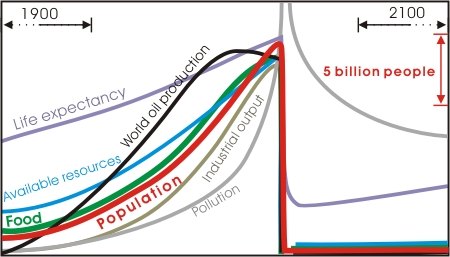
Not really difficult to interpret these graphs, but for the sake of getting the message across, it's obvious that if human population growth continues the way it is, the consequences for the planet will be dire.
A quote which I think emphasises an important issue of population growth which is perhaps less considered than it should be in an age where technological advancements are strengthening our desire to live longer and stronger, defying age, and in turn cementing our opinion that we are superior;
"While the human population grows, the earth's size and resources remain the same. Technology can increase the amount of food that can be produced on a piece of land, but it cannot increase the amount of land and water on the planet."
Furthermore, I believe this particular paragraph;
"Environmental problems are aggravated by population explosions. More people means more resources and energy are consumed and more pollution is created and more waste is sent to landfills. More land is needed to grow crops and build houses. More trees are cut down for new homes. More cars are built, more fossil fuels are used, and more gases are released into the environment. More natural wilderness areas or beautiful landscapes are destroyed to provide resources and cropland. In short, population growth makes other environmental problems harder to solve."
sums up well my thoughts on why it is less important to settle the debate on climate change / global warming than it is to act on changing our behaviour for the problems we know and agree exist.
I highly recommend you read this article

Tuesday, October 5, 2010
Nurturing the Roots
A very interesting thought was brought to my attention today, by a rather great, wise man:
"as a society/a world with so many problems should we fix one problem at a time starting from the root cause or should we try and fix them all at once(ie 3rd world countries, animal cruelty etc)
if we fix all of them at once we may have no impact, if we focus on one and work through them we may neglect animals or starving people for a period but ultimately wouldn't we fix the problem?"
My initial response to this:
"the idea of starting from the root cause has merit though; dealing with the base issues to prevent the actual problems worsening, or others developing in the future. You're right - trying to focus on all at once may have no impact - would probably be slightly chaotic, could even make things worse."
And to continue from this:
Yes, eventually, if we were consistent with trying to resolve issues bit by bit, ultimately we probably would fix the problems. Unfortunately, for a great deal of progress it would require a change in attitude by a large portion of the world's population.. or at least that of developed nations. In saying that, I definitely believe it's possible for one person to inspire a crowd that can have huge influence - as has been done repeatedly throughout history. The problem that comes to mind with this is - while there are people creating positive progress with these problems, a larger part of the population continues to act counter-effectively, by consuming products that perhaps aren't ethically produced (such as free trade) or consuming the products of animals kept in caged or otherwise intensive farming systems.
To work on one problem at a time - would we experience guilt at the thought of perhaps neglecting the other creatures suffering, whether they be human or other animal? Or would concentration on one problem result in increased difficulties for the other issues?
In general, I think there is a lot to be said for dealing with the root cause of any issue - whether that be the emotional difficulties experienced by an individual, or the poverty experienced by a nationwide population; if you nurture the foundations, then surely the stem and branches will be better nourished.
Monday, October 4, 2010
Happy World Animal Day!
World Animal Day certainly seems a fitting topic for a blog observing and, in some ways, attempting to analyse the world; animals are a crucial part of the world and its atmosphere.. and no, I don't necessarily mean 'atmosphere' in terms of the gases circulating the globe.. I'm talking about the general emotional experience on Earth.
Animals are therapeutic. They're protective; they're nurturing. They're loyal. They (mostly) love unconditionally. They're intelligent.. much more so than many humans will give them credit for.
A youtube search for 'animal heroes' is simple proof of how incredible they are, and can be. Here's a video detailing the Animal Heroes of 2006 - Animals that have saved human lives and showed outstanding bravery, courage and intelligence:
It also seems fitting to include a few awesome quotes:
"The greatness of a nation and its moral progress can be judged by the way its animals are treated." - Ghandi
"Aerodynamically, the bumble bee shouldn't be able to fly, but the bumble bee doesn't know it so it goes on flying anyway." - Mary Kay Ash
"Horse sense is the thing a horse has which keeps it from betting on people." - W. C. Fields
"A dog is the only thing on earth that loves you more than he loves himself." - Josh Billings
Finally, the Universal Declaration on Animal Welfare - please read and sign the petition - it takes just a few moments of your time.
www.udaw.org
http://www.animalsmatter.org/en/campaign_resources/
And finally (for real this time!) a thought to ponder...
"One interesting finding is that 99% of Australians are against cruelty to animals, yet 98% eat animals and fish that come from cruel, intensive farming practices!" (A Pound of Flesh, http://www.scribd.com/doc/26880337/APF-VVSQ)
As Ghandi says.. 'you must be the change you want to see in the world'.
Here's to all animals
Animals are therapeutic. They're protective; they're nurturing. They're loyal. They (mostly) love unconditionally. They're intelligent.. much more so than many humans will give them credit for.
A youtube search for 'animal heroes' is simple proof of how incredible they are, and can be. Here's a video detailing the Animal Heroes of 2006 - Animals that have saved human lives and showed outstanding bravery, courage and intelligence:
It also seems fitting to include a few awesome quotes:
"The greatness of a nation and its moral progress can be judged by the way its animals are treated." - Ghandi
"Aerodynamically, the bumble bee shouldn't be able to fly, but the bumble bee doesn't know it so it goes on flying anyway." - Mary Kay Ash
"Horse sense is the thing a horse has which keeps it from betting on people." - W. C. Fields
"A dog is the only thing on earth that loves you more than he loves himself." - Josh Billings
Finally, the Universal Declaration on Animal Welfare - please read and sign the petition - it takes just a few moments of your time.
www.udaw.org
http://www.animalsmatter.org/en/campaign_resources/
And finally (for real this time!) a thought to ponder...
As Ghandi says.. 'you must be the change you want to see in the world'.
Here's to all animals
Wednesday, September 29, 2010
The Epitome of Beauty
Something I love about photography is the way it manages to capture solitary, magical moments in time. Moments that will never be repeated in exactly the same manner, but that help to define what life is about, and immortalize the incredible actions and elements of nature.
Follow this link to see some truly amazing shots by a talented man (mine :P).
http://illuzian.deviantart.com/
Follow this link to see some truly amazing shots by a talented man (mine :P).
http://illuzian.deviantart.com/
The Ropes of Our Pasts
"I have confidence, in confidence alone
Besides which you see I have confidence in me" - Julie Andrews, "The Sound of Music"
Confidence... probably the biggest obstacle between each of us and our dreams.
Whether we like or believe it or not, what we have experienced in the past does have an impact on how we feel in the present. However big or small our past trials and triumphs have been, they have an influence on how we perceive situations in the present, how we react to them, and how we feel we can deal with them.
That by no means goes to say that the level of confidence we feel in ourselves dictates what we can achieve; absolutely not. It is simply fears we have that cause us to doubt ourselves and our potential.
I think there is a lot of truth to the saying that we are each our own worst critic. Many of us find it difficult to accept compliments, but will readily admit our faults. This is, to me, why bullying is especially terrible, particularly in primary school where we are learning about ourselves and might not quite understand truth from lie, or teasing.
I'm currently watching Stranger than Fiction, and find the whole concept quite fascinating; Harold's life is being narrated... the voice either tells him everything he is doing, or tells him what is going to happen. Perhaps if we each had a voice like this tracking our thoughts, we would feel a lot more confident; and a lot less alone; in doing things. This voice transforms Harold's life as he realises he is capable of more. He finds love and passion. There is a lot to be said for moral support and understanding.
Confidence is clearly not simply about achieving things externally to ourselves; our internal thoughts can be very difficult to control, given the mind is such a powerful tool; our thoughts can be overbearing enough to totally distort what we see as truth and reality.
As a finishing thought, there is much to be said for smiling and greeting strangers on the pathway, and random, spontaneous, uplifting acts... break the routine, break from the crowd... cliche as it may sound, it is individuality that makes the world a more interesting and exciting place.
Subscribe to:
Posts (Atom)